
The key of F has 7 diatonic chords within it: F major, G minor, A minor, Bb major, C major, D minor, and E diminished.
Roman numerals are often used to represent these chords, because then the chord progression can then be moved easily or compared to any other major key. All major keys follow the same chord and scale structure, hence the value of using the roman numerals:
F major = I
G minor = ii
A minor = iii
Bb major = IV
C major = V
D minor = vi
E diminished = vii
Notice the major chords have upper-case roman numerals, and minor / diminished chords have lower case roman numerals. In every major key the I chord is major, the ii chord is minor, the iii chord is minor, the IV chord is major, etc. All major keys are the same structure, what changes between them is the notes within, and the note the scale starts on.
If we remove the E diminished chord from this list and look at the remaining six chords, they can then be coupled together based on relative major and minor:
F major / D minor or I / vi
Bb major / G minor or IV / ii
C major / A minor or V / iii
The idea is to use three different pentatonic forms in the 5th fret position to solo over these six chords:
F major / D minor or I / vi = Form 4
Bb major / G minor or IV / ii = Form 2
C major / A minor or V / iii = Form 1
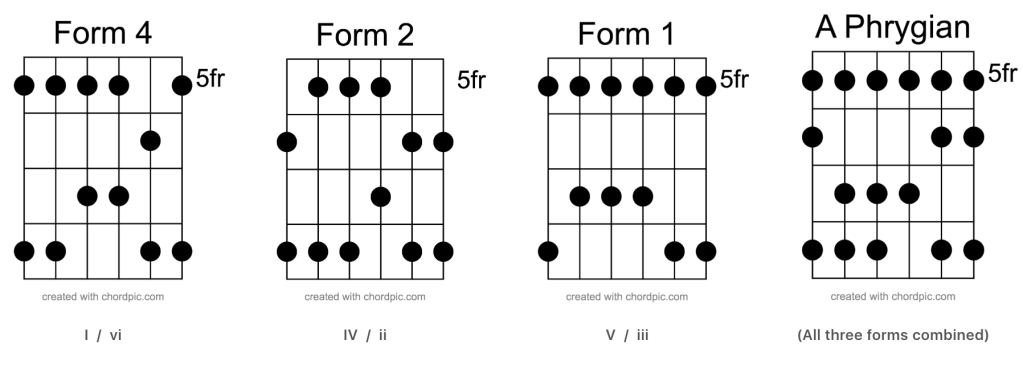
It takes a while to absorb this into the fingers and ears, but the concept is to use the appropriate pentatonic form within the Phrygian position to access the chord tones of each chord. You can also just use Phrygian as a whole to put in runs and other embellishments, but use the pent forms to guide you to the correct chord tones.
 Drew Krag Music